Residence & Work Permits in Switzerland For Non‑EU/EFTA and UK Nationals
1. Overview
All non‑EU/EFTA nationals who wish to live and work in Switzerland for more than 8 days in a calendar year must obtain a valid work permit before starting employment. Unlike EU/EFTA citizens, non‑EU/EFTA nationals do not benefit from the Agreement on the Free Movement of Persons. Their employers must apply for a permit in advance and demonstrate compliance with Swiss labor market requirements.
Family members of permit holders are eligible to stay in Switzerland, but the application process depends on the nationality.
EU: EU member states that are part of the Agreement on the Free Movement of Persons:Austria, Belgium, Croatia, Denmark, Finland, France, Germany, Greece, Ireland, Italy, Luxembourg,Netherlands, Portugal, Spain, Sweden, Cyprus, Malta, Bulgaria, Czech Republic, Estonia, Hungary, Latvia,Lithuania, Poland, Romania, Slovakia, Slovenia
EFTA: Iceland, Liechtenstein, Norway
Non-EU/EFTA: all other states including UK
2. Permit Types
For non-EU/EFTA nationals, the type of Swiss permit required is determined by the following factors:
- The duration of the stay in Switzerland
- The location of the individual’s primary residence (Switzerland or an EU/EFTA country, in the case of cross-border commuters)
- Whether the employment contract is with a Swiss legal entity or a foreign legal entity
Short‑Term and 120‑Day Authorizations
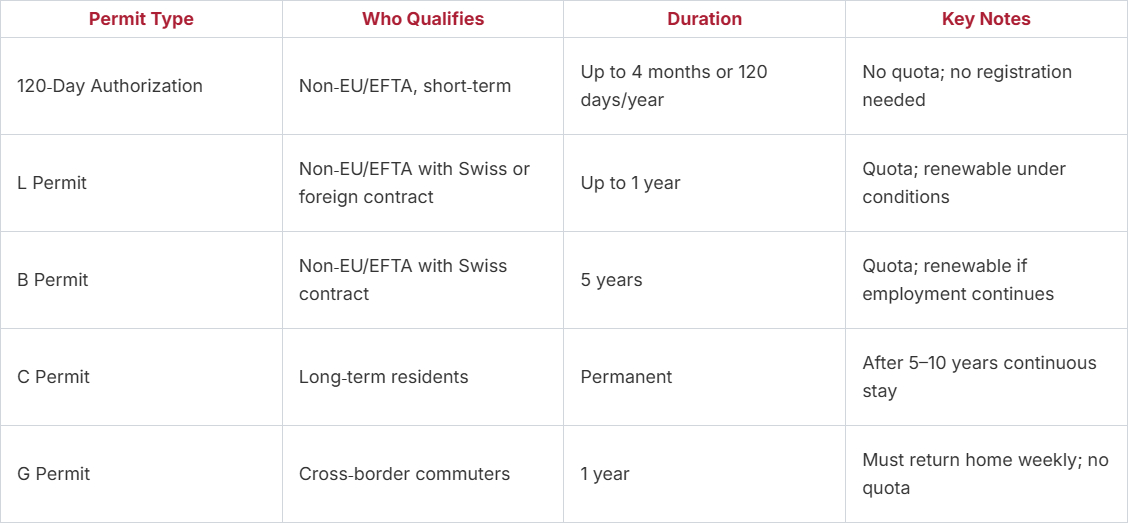
These authorizations apply to non-EU/EFTA nationals working in Switzerland for up to four consecutive months or a total of 120 days within a 12-month period. They can be based on either a Swiss or foreign labor contract.
Limitations: Depending on the authorization type and cantonal practice, a cooling-off period outside Switzerland may apply before a new short-term authorization can be granted. During the stay, salary and benefits must align with Swiss standards. Short-term authorizations (in particular stays of less than four months) are generally not subject to quotas.
Procedure: Employers must apply to cantonal authorities prior to work commencement. Upon approval, an authorization is issued allowing the employee to work legally. Local registration is generally not required.
L and B Permits
L Permit – For stays of up to one year; generally extendable up to a total duration of 24 months, provided the Swiss employment contract is extended. Extensions beyond this duration may be possible in specific cases, depending on the legal basis and cantonal practice.
B Permit – For long-term stays beyond one year. For non-EU/EFTA nationals, the B permit is typically issued for one year at a time and renewed annually as long as a Swiss employment contract remains in place. It is generally not granted or renewed for foreign labor contracts.
Quota: L Permit – 4,000 per year; B Permit – 4,500 per year. Additional quota for UK nationals: 1,400 L permits and 2,100 B permits per year.
Recruitment obligation: Swiss employers must demonstrate that no suitable Swiss or EU/EFTA candidates could be recruited before applying for a non-EU/EFTA permit (labour market precedence). In certain occupations, vacancies must be registered with the Regional Employment Centre (RAV). Exceptions apply to intra-company transfers and certain specialist roles.
Procedure: Employer applies to cantonal authorities. Upon approval, the employee receives an authorization (Ermächtigung zur Visumerteilung / autorisation habilitant à délivrer un visa) to apply for an entry visa if required. Holders of a valid Schengen residence permit are exempt from the visa requirement.
C Permit (Permanent Residence)
The C permit allows permanent residence after a long-term stay in Switzerland. It is typically granted to non-EU/EFTA nationals who have held a B permit for at least 10 years based on a Swiss work agreement. Citizens of the USA and Canada may qualify after five years. Applicants must demonstrate proficiency in a local language.
Validity: Settlement status is unlimited; the permit card is renewed periodically (typically every five years).
Procedure: Application is submitted to the local municipality or cantonal migration office.
G Permit (Cross‑Border Commuters)
Applicable to non-EU/EFTA nationals with a Swiss labor contract who hold permanent residence status in an EU/EFTA country and return to their country of residence at least once a week. The commuter must have resided in the country of residence for at least six months prior to application.
The G permit is issued for the duration of the employment contract, typically up to one year, and is renewable as long as the employment continues. In some cases, validity may extend for longer periods depending on cantonal practice. Commuters who stay overnight in Switzerland must register their secondary residence locally.
Procedure: Application with cantonal authorities before taking up work (in some cantons within 14 days).
3. Key Notes & Conditions
- Salary levels must comply with Swiss market standards (www.entsendung.admin.ch/Lohnrechner).
- Family reunification is possible, subject to nationality and residence permit type.
- Non‑EU/EFTA nationals face quotas and additional hiring justification requirements.
- Visa issuance may depend on nationality and residence status.
4. Quick Reference Table