
Residence & Work Permits in Switzerland for EU/EFTA Nationals
1. Overview
Every foreign national who wishes to live and work in Switzerland for more than 8 days per calendar year requires a work and residence permit. EU/EFTA citizens benefit from the Agreement on the Free Movement of Persons, which simplifies their right to work and reside in Switzerland. The type of permit required depends on nationality, length of stay, residence, and the nature of the employment contract.
While their right to obtain a permit is generally guaranteed, registration and compliance with Swiss employment standards (especially salary levels) are mandatory. UK citizens and other non‑EU/EFTA nationals are subject to quotas and additional conditions.
2. Definitions
EU: EU member states that are part of the Agreement on the Free Movement of Persons: Austria, Belgium, Croatia, Denmark, Finland, France, Germany, Greece, Ireland, Italy, Luxembourg, Netherlands, Portugal, Spain, Sweden, Cyprus, Malta, Bulgaria, Czech Republic, Estonia, Hungary, Latvia, Lithuania, Poland, Romania, Slovakia, Slovenia
EFTA: Iceland, Liechtenstein, Norway
Non-EU/EFTA: all other states including UK
3. EU/EFTA Nationals with a Swiss Employment Contract
Citizens of the EU and EFTA working under a Swiss employment contract are covered by the Agreement on the Free Movement of Persons. This means:
- Work permits are generally guaranteed
- No annual quotas apply
- Registration with local Swiss authorities is mandatory and automatically leads to a valid residence and work permit
Croatian nationals have been fully included in this agreement since 1 January 2022.
Important note on UK nationals: The United Kingdom is no longer part of the EU and therefore no longer benefits from free movement. UK citizens are subject to annual quotas, although the notification procedure (for short-term work) still applies.
4. Job Registration Requirement in Switzerland
To protect the local workforce, Swiss employers must register job vacancies in professions where unemployment exceeds certain thresholds:
- Above 8% unemployment (prior rule)
- Above 5% unemployment (rule applicable since 1 January 2020)
Vacancies must be registered with the Regional Employment Office (RAV/ORP) or online via arbeit.swiss.
This requirement mainly affects sectors such as:
- Construction
- Agriculture
- Hospitality & catering
- Certain marketing roles
5. EU-EFTA Posted Employees (Assignments from Abroad)
EU/EFTA nationals who remain employed by a foreign company and are temporarily assigned to Switzerland do not fall under free movement rules.
- For assignments exceeding 90 days, a work permit is required
- These permits are subject to annual quotas
6. Salary Compliance (Very Important)
All foreign workers in Switzerland—whether locally employed or posted—must receive a salary in line with Swiss market standards.
Swiss authorities closely review salary levels, especially for posted employees. To assess compliance, authorities use the SECO national wage calculator, which considers:
- Age
- Education
- Industry
- Professional experience
7. Family Members
Family members of EU/EFTA permit holders are allowed to live in Switzerland regardless of nationality. However, the residence permit process depends on the family member’s citizenship.
8. Permit Types
The applicable residence permit is determined based on the length of stay, the place of residence, and the type of employment contract.
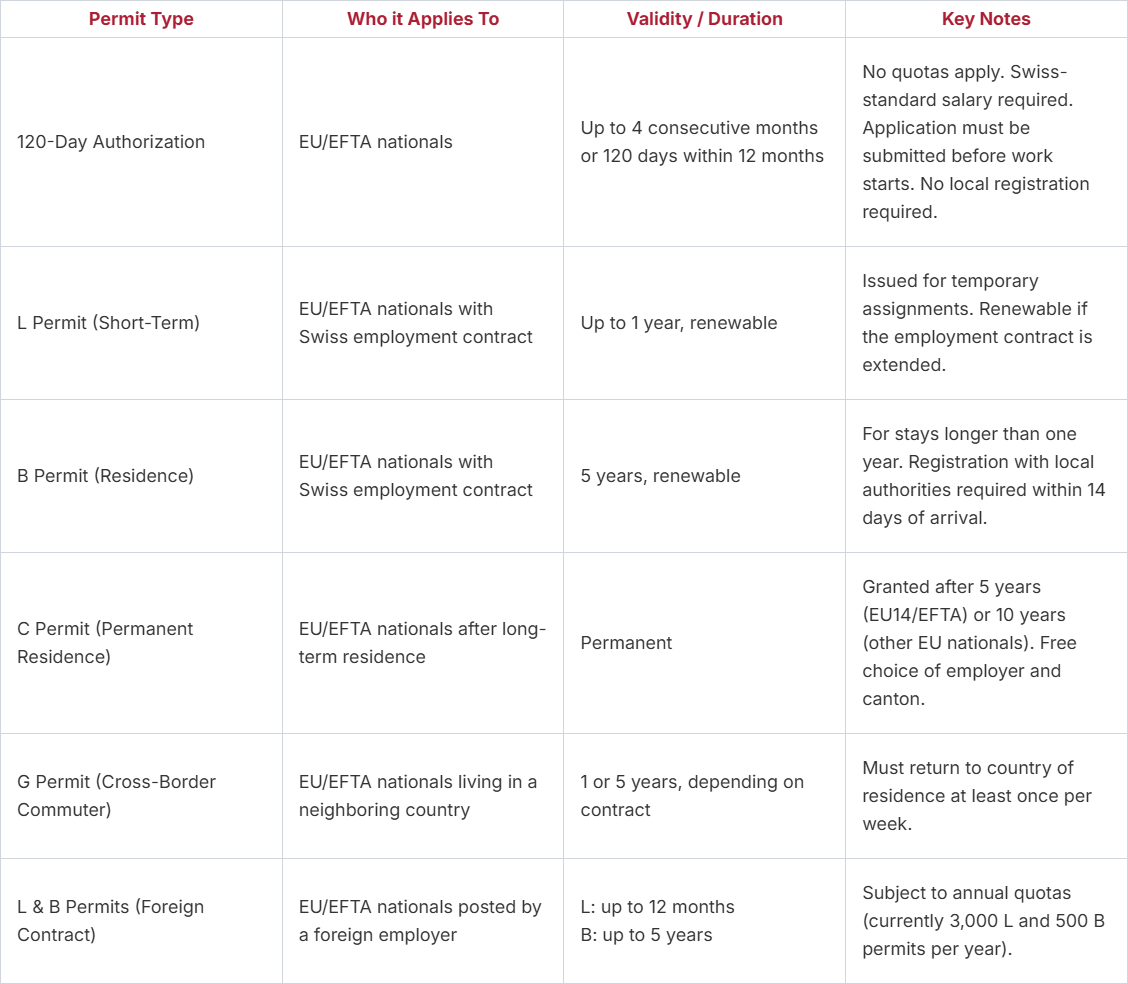
120‑Day Authorization
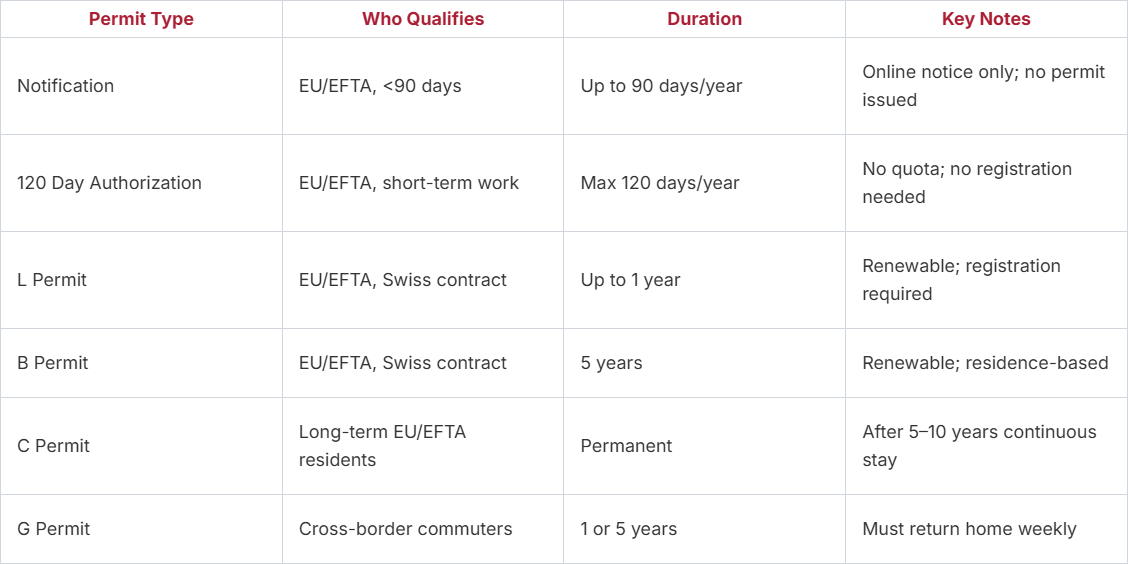
Allows EU/EFTA nationals to work in Switzerland up to 4 consecutive months or a total of 120 days within 12 months. No quotas apply. A salary aligned with Swiss standards is required.
Application: Employer or representative applies to cantonal authorities before work starts. No local registration required.
L and B Permits (Swiss Employment Contract)
L Permit – Short‑term residence for up to one year; renewable if the Swiss employment contract is extended.
B Permit – Residence for more than one year; valid for 5 years and renewable. Registration with local authorities within 14 days of arrival is required.
C Permit (Permanent Residence)
Granted to EU14/EFTA nationals after 5 years of continuous residence, and to other EU nationals after 10 years. It allows permanent settlement and free choice of employer or canton.
G Permit (Cross‑Border Commuters)
For EU/EFTA nationals who live in a neighboring EU/EFTA country but work in Switzerland, returning home at least once a week. Valid for 1 or 5 years depending on the employment contract.
L and B Permits (Foreign Employment Contract)
Applicable to EU/EFTA nationals posted to Switzerland by a foreign employer.
- L Permit: issued for short-term assignments, typically up to 12 months
- B Permit: issued for longer-term postings, valid for up to 5 years
Both permit types are subject to annual quotas (currently 3,000 L permits and 500 B permits per year).
3. Key Notes & Conditions
- Salaries must meet Swiss standards (check: www.entsendung.admin.ch/Lohnrechner).
- Family members of EU/EFTA permit holders may reside in Switzerland under family reunification rules.
- Some job openings must be advertised with Swiss employment centers before hiring foreign staff.
- Quotas apply only to certain categories (mainly posted workers and UK nationals).
4. Quick Reference Table
Notification Procedure
Applicable to EU/EFTA nationals (and UK citizens) working in Switzerland for less than 90 days per calendar year. Employers must notify Swiss authorities at least 8 days before work begins.
Proof of compliance: Email confirmation of notification.